Friday, July 12, 2013

The Mets in All-Star Games Part 3: The 1980s


Mets' ace Dwight Gooden started the All-Star Game for the National League twice in his career.

Shale Briskin
MM Assistant Editor

The 1980s did not begin much better than the late 1970s for the Mets, but by the middle of the decade, the Mets would begin their best seven-year stretch in team history, which culminated in two division titles and a World Series championship in 1986. Along the way, the Mets of the 1980s featured quite a few All-Stars.
1980: Catcher John Stearns was the Mets' lone All-Star in 1980 and made his third appearance at the Midsummer Classic. Stearns batted .285 with no home runs and 45 RBI before suffering a season-ending finger injury in late July. He did not get a hit in his only All-Star Game at-bat.

1981: In 1981, right fielder Joel Youngblood was the Mets' only All-Star. In the strike-shortened season, Youngblood batted .350 in 143 at-bats with 4 home runs and 25 RBI. Youngblood's only at-bat at the All-Star Game was as a pinch-hitter and he did not get on base.

1982: Stearns made his fourth and final appearance at the 1982 All-Star Game. Once again, he was the only Met at the festivities. While batting .293 with 4 home runs and 28 RBI in 98 games, Stearns did not get an at-bat at the Midsummer Classic.

1983: In 1983, closer Jesse Orosco made the first of two consecutive appearances to the All-Star Game. He was the Mets' lone representative. Orosco had a 13-7 record as a closer, to go along with a 1.47 ERA and 17 saves. Orosco pitched 1/3 of an inning at the All-Star Game and got a strikeout.

1984: In 1984, the Mets were finally on the rise and had four All-Stars to show for it. One of them was their rookie ace Dwight Gooden, who won the 1984 NL Rookie of the Year Award by going 17-9, with a 2.60 ERA and a career high 276 strikeouts. Gooden pitched two innings in the All-Star Game and allowed just one hit, while striking out three.

Another first time All-Star was young right fielder Darryl Strawberry, who preceded Gooden as the 1983 NL Rookie of the Year. Strawberry batted .251 with 26 home runs, 97 RBI and 27 stolen bases. He also started in right field and had one hit in two at-bats, plus a stolen base at the All-Star Game.

Veteran first baseman Keith Hernandez also made his first trip to the All-Star Game as a Met. Hernandez batted .311 with 15 home runs, 94 RBI and a .409 OBP. Hernandez struck out in his only at-bat at the Midsummer Classic.

Rounding out the group was Orosco, who had one of his best seasons as a Met. Orosco went 10-6 with a 2.59 ERA and 31 saves. He did not pitch in the All-Star Game.

1985: The 1985 Mets had four All-Stars as well, with two having participated a year earlier.

Gooden had one of the best pitching seasons in not just Mets history, but also baseball history. He had an amazing 24-4 record, a 1.53 ERA and 268 strikeouts. Gooden did not pitch in the All-Star Game that year.

Strawberry had another great season with a .277 average, 29 home runs, 79 RBI and 26 stolen bases. He had a hit, a walk and two runs scored in the All-Star Game.

New catcher Gary Carter gave the Mets the extra offensive boost they needed, with a .281 average, 32 home runs and 100 RBI. He did not participate in the All-Star Game though.

Pitcher Ron Darling also made the 1985 NL All-Star team. It would be the only trip to the Midsummer Classic in Darling's career. Darling went 16-6 with a 2.90 ERA and 167 strikeouts that year, but did not appear in the All-Star Game.

 Right fielder Darryl Strawberry started in five consecutive All-Star Games from 1984-1988.


1986: The eventual World Series champions set a then-franchise record with five All-Stars.

Gooden became the youngest pitcher to ever start the All-Star Game that year. Unfortunately, he struggled that day and gave up two runs and three hits in three innings pitched. For the year, Gooden was 17-6 with a 2.84 ERA and 200 strikeouts.

Strawberry started the All-Star Game in right field and had one hit in two at-bats. His season included a .259 average, 27 home runs, 93 RBI and 28 stolen bases.

Hernandez started the All-Star Game at first base, but was hitless in four at-bats. He batted .310 with 13 home runs and 83 RBI for the year.

Carter was the starting catcher at the All-Star Game, but he himself was hitless in three at-bats. Carter's season featured a .255 average, 24 home runs and 105 RBI.

The fifth All-Star was left-hander Sid Fernandez, who pitched one inning in the All-Star Game and allowed two walks, while striking out three. Fernandez was 16-6 with a 3.52 ERA and 200 strikeouts for the season.

1987: The 1987 Mets featured four All-Stars in Strawberry, Hernandez, Carter and Fernandez. Both Carter and Strawberry started the game for the National League.

Strawberry had arguably the best season of his career in 1987. He batted .284 with a new Mets single season record of 39 home runs (which was later broken by Todd Hundley in 1996 and tied by Carlos Beltran in 2006), to go along with 104 RBI and 36 stolen bases. Strawberry was hitless in his two All-Star Game at-bats that year.

Hernandez batted .290 with 18 home runs and 89 RBI in what was essentially the last great season of his long career. He had one hit in three at-bats during the All-Star Game.

Carter batted just .235 in 1987, but had 20 home runs and 83 RBI as well. He had one walk in two plate appearances at the All-Star Game.

Fernandez went 12-8 with a 3.81 ERA that year and got the save in the Midsummer Classic with one and one strikeout in one inning pitched.

1988: In 1988, the Mets had four All-Stars once had. Three were familiar faces, but one was a newcomer.

Gooden went 18-9 with a 3.21 ERA and 175 strikeouts that year and started the All-Star Game for the second time in his career. He allowed a home run to Terry Steinbach, as well as two other hits and a walk in three innings pitched that day.

Strawberry once again started in right field at the Midsummer Classic and had one hit in four at-bats. For the season, Strawberry batted .269 with 39 home runs, 101 RBI and 29 stolen bases. Strawberry ended up finishing in second place in the 1988 National League MVP voting.

In his 11th and final trip to the All-Star Game, Carter started behind the plate and had one hit in three at-bats. He batted .242 with 11 home runs and 46 RBI that year.

The newcomer was right-handed pitcher David Cone, who had his best season as a Met by going 20-3 with a 2.22 ERA and 213 strikeouts. He finished third in the 1988 NL Cy Young Award voting. At the All-Star Game that year, Cone threw a scoreless inning with one strikeout.

1989: Closing out their most successful decade yet, the Mets had two All-Stars in 1989.

Darryl Strawberry batted .225 with 29 home runs and 77 RBI that year, but did not participate in the All-Star Game.

Third baseman Howard Johnson his first of two career trips to the Midsummer Classic in 1989. At that point, Johnson's 1989 season was his best. It included a career high .287 average, 36 home runs, 101 RBI and a career high 41 stolen bases. Johnson had one hit in three at-bats, plus a stolen base in the 1989 All-Star Game.

Stay tuned for the next installment, in which we recap the Mets' All-Star Game performances of the 1990s.

The Mets in All-Star Games Part 2: The 1970s


Shale Briskin
MM Assistant Editor

As the Mets moved to the 1970s fresh off their first championship in team history, their next decade would be inconsistent at first, but very poor at the end. In the middle of all this would be a trip to the World Series in which the Mets lost to the Oakland A's in seven games.

1970: The defending champions had two All-Stars in 1970. Tom Seaver made his fourth consecutive trip to the Midsummer Classic. He pitched three shutout innings in the game and gave up just one hit, with four strikeouts. For the season, Seaver went 18-12 with a 2.82 ERA and 283 strikeouts.

Longtime shortstop Bud Harrelson made his first of two consecutive trips to the All-Star Game. He had two hits and two runs scored in three at-bats during the game. Harrelson's full season included a .243 average, 1 home run and 42 RBI, plus a career high in walks with 95.

Manager Gil Hodges managed the National League team for the only time in his career.

1971: Similar to 1970, Seaver and Harrelson were once again the only Mets' All-Stars that year. Seaver did not pitch in the game that year, while Harrelson was hitless in two at-bats. Seaver though had one of the best seasons in his career, with a 20-10 record, a career best 1.76 ERA, and a career high 289 strikeouts. Harrelson batted .252 with no home runs and 32 RBI.

1972: In 1972, the Mets made one of their biggest trades to that point by acquiring the legendary Willie Mays from the Giants. In 69 games, Mays batted .267 with 8 home runs and 19 RBI. In the All-Star Game, Mays was hitless in two at-bats.

Seaver made yet another All-Star Game appearance, but for the second consecutive season did not play in the game itself. Seaver went 21-12 with a 2.92 ERA and 249 strikeouts for the season.

Closer Tug McGraw made his first All-Star Game trip that year to round out the Mets' participants. McGraw ended up getting the win in the 1972 Midsummer Classic by pitching two scoreless innings and allowing just one hit, while striking out four. McGraw's full season included an 8-6 record, a 1.70 ERA and 27 saves.

1973: The 1973 National League Champions came out of nowhere to win the NL East division title. By midseason though, they were not playing particularly well. As a result, the Mets only had two All-Star representatives in future Hall of Famers Seaver and Mays that year.

Seaver won his second NL Cy Young Award by going 19-10 with a 2.08 ERA and 251 strikeouts. He pitched one inning in the Midsummer Classic and allowed one walk. Mays was hitless in his only All-Star Game at-bat that season. He batted .211 with 6 home runs and 25 RBI in what would be the final season of his career.

1974: The 1974 NL All-Star team had a notable player missing from the roster. It was the only season in Tom Seaver's time with the Mets in which their ace did not make the All-Star team. Instead, young sothpaw Jon Matlack and catcher Jerry Grote represented the Mets.

Matlack was 13-15 with a 2.41 ERA and 195 strikeouts. In the All-Star Game, Matlack pitched a scoreless inning with one hit and one walk allowed. Grote was hitless in his only at-bat, while he batted .257 with 5 home runs and 36 RBI for the season.

Mets manager Yogi Berra also managed the National League team that year.

1975: In 1975, Seaver and Matlack were the Mets' All-Stars as the team had a .500 season more or less.

Seaver won his third NL Cy Young Award that year with a 22-9 record, a 2.38 ERA and 243 strikeouts. He pitched an inning in the All-Star Game, but allowed three runs, two hits and a walk in what was easily his worst ever performance in the Midsummer Classic.

Matlack had another great season himself with a 16-12 record and a 3.38 ERA. In the All-Star Game, Matlack became the first Met to win MVP honors, although he was a co-MVP with Bill Madlock. Matlack got the win and pitched two shutout innings with four strikeouts, while giving up just one hit.


Left-handed pitcher Jon Matlack was the Co-MVP in the 1975 All-Star Game.

1976: In 1976, newcomer Dave Kingman joined Seaver and Matlack in the All-Star Game. In a season that saw him set a Mets' then-single season record with 36 home runs, Kingman also contributed 86 RBI, despite a .238 average. Kingman was hitless in both of his at-bats at the Midsummer Classic.

Seaver went 14-11 with a 2.59 ERA and 235 strikeouts that year and allowed one home run in the All-Star Game, while pitching two innings. Matlack was 17-10 with a 2.95 ERA for the season, but did not pitch in the All-Star Game.

1977: 1977 is not fondly remembered by Mets fans at all. It was the year in which Seaver and Kingman were both traded the exact same day and the Mets never recovered from the "Midnight Massacre" for the rest of the decade.

While Seaver was an All-Star once again, but this time as a member of the Reds, catcher John Stearns would become the Mets' lone player at the All-Star Game, which took place in Yankee Stadium that year.

In his rookie season, Stearns batted .251 with 12 home runs and 55 RBI. He also had a .370 OBP and 9 stolen bases. Stearns did not get a hit in his lone at-bat at the Midsummer Classic.

1978: The Mets' struggles continued in 1978 and Pat Zachry was the Met to be named to the All-Star Game.

Zachry went 10-6 with a 3.33 ERA in 21 starts that year, but did not pitch in the All-Star Game.

1979: The Mets once again were not a good team in 1979, but did have multiple representatives at the All-Star Game that year in Stearns and outfielder Lee Mazzilli.

Stearns batted .243 with 9 home runs and 66 RBI that year, but did not play in the All-Star Game. Mazzilli though had a breakout season with a .303 average, 15 home runs, 79 RBI, 34 stolen bases and a .395 OBP. At the Midsummer Classic, Mazzilli did not start the game, but later became the first Mets hitter to hit a home run in his first ever All-Star Game at-bat. It was a two-run home run that helped the National League win 7-6. Mazzilli drew a walk in his only other at-bat.

Stay tuned for the next installment, in which we recap the Mets' All-Star Game performances of the 1980s.

Tuesday, July 9, 2013

The Mets in All-Star Games Part 1: The 1960s


Shale Briskin
MM Assistant Editor

With the 2013 MLB All-Star Game a week away, I will now be starting a short series that includes the performances of each Met in each All-Star Game since 1962. This year is the first since 1964 in which the Mets have hosted the game itself and David Wright and Matt Harvey will be the Mets' two representatives this year.
But who represented the Mets in other years? And how did their Midsummer Classic performances go? Let's find out! We begin with the 1960s.

1962: There was not much good at all about the Mets' inaugural season. The "Loveable Losers" set a new major league record with a 40-120 final record, that still stands today as the worst record of all time. Despite all this, there were a few notable bright spots. Frank Thomas hit 34 home runs and drove in 94 RBI, which were Mets' single season records for a while. And then there was Richie Ashburn.

A future member of the Baseball Hall of Fame, Ashburn spent the final season of his career with the Mets in 1962. He was arguably the Mets' best hitter that year with a .306 average, 7 home runs, 28 RBI and a .424 OBP. He was the Mets' lone All-Star as well. In 1962, there were two All-Star Games. Ashburn did not play in the first game, but got a single in his only at-bat in the second game.

1963: The Mets' second season featured the return of Brooklyn Dodgers legend, Duke Snider. In Snider's second to last season of his career, he batted .243 with 14 home runs and 45 RBI. Despite his skills declining by then, he was a great veteran presence on a Mets team that was searching for an identity. Snider was the Mets' only All-Star that year and struck out in his only at-bat in the game itself.

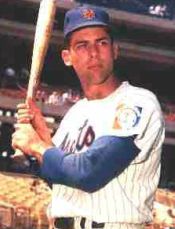
 Second baseman Ron Hunt, the Mets' first ever starter in All-Star Game history.

1964: 1964 was a special year for the Mets. Not only did Shea Stadium open, but this was also the only season in which Shea Stadium ever hosted the Midsummer Classic in its 45-year history.

Unfortunately, the Mets only had one of its players in the game, and that was second baseman Ron Hunt. Hunt became the first Met in All-Star Game history to start in the game. He ended up going 1-for-3 at the plate that day with a single. For the year, Hunt finished with a .306 average, 6 home runs, 42 RBI and a .357 OBP.

1965: In 1965, the Mets once again had just one player in the All-Star Game. Longtime Met Ed Kranepool made his only All-Star Game appearance in his 18-year career. However, he did not play in the game itself. For the year, Kranepool batted .253 with 10 home runs and 53 RBI.

1966: In 1966, Ron Hunt would become the first Met to make multiple trips to the All-Star Game. However, he had just one at-bat this time around and did not reach base. Hunt batted .288 with 3 home runs and 33 RBI for the season.

1967: By 1967, the Mets were finally starting establish a direction of some sort. And that started with their new rookie ace, Tom Seaver. The eventual 1967 NL Rookie of the Year, Seaver pitched in the 15 inning of the Midsummer Classic and recorded the save by allowing just one walk to Carl Yasterzemski before finishing off the National League's 2-1 victory. Seaver's rookie season included a 16-13 record, a 2.76 ERA and 170 strikeouts. This would be first of many All-Star Game appearances for Seaver.

1968: For the first time, the Mets actually made more than one representative at the All-Star Game in 1968. Tom Seaver had another great season that year, with a 16-12 record, a 2.20 ERA and 205 strikeouts. He was also joined by rookie southpaw Jerry Koosman, who finished second in the 1968 NL Rookie of the Year voting. Koosman went 19-12 that year with a 2.08 ERA and 178 strikeouts. Also joining the two pitchers was catcher Jerry Grote. Grote was always more known for his defense, but contributed a .282 average, 3 home runs and 31 RBI at the plate as well.

In the 1968 Midsummer Classic, Seaver pitched both the seventh and eighth innings and struck out five batters, with two of them being Yastrzemski and Mickey Mantle. Koosman then came in to close the game in the ninth inning and got the final out, relieving Ron Reed of the Braves. Grote was hitless in his two at-bats.

1969: In 1969, the Mets shocked the world by winning 100 games and eventually the 1969 World Series. Joining Seaver and Koosman at the All-Star Game that year was left fielder Cleon Jones, who had a career season that year with a .340 average, 12 home runs, 75 RBI and a .422 OBP. Jones started in left field at what would turn out to be the only Midsummer Classic he was a part of. He went 2 for 4 at the plate with 2 runs scored.

In what was arguably the best season of his career, Seaver won his first of three NL Cy Young Awards. He went 25-7, with a 2.21 ERA and 208 strikeouts. Seaver though did not end up pitching in the All-Star Game that year.

Not to be outdone, Koosman held his own with a 17-9 record, a 2.28 ERA and 180 strikeouts that season. Koosman pitched in the seventh inning and part of the eighth inning of the 1969 All-Star Game. In 1.2 innings pitched, Koosman allowed just one hit.

Stay tuned for the next installment, in which we recap the Mets' All-Star Game performances of the 1970s.

Sunday, June 23, 2013

First half memorables for the Mets

Lucas Duda
Lucas Duda (Photo credit: Wikipedia)
Ike Davis
Ike Davis (Photo credit: Wikipedia)
Justin Turner
Justin Turner (Photo credit: Wikipedia)
Jon Niese 1
Jon Niese 1 (Photo credit: Up Along First)
Wendy Adair
Editor/Contributor

The first half of the 2013 season is almost over and the Mets have had a memorable if not extremely disappointing first half so far.

It is clear that this team needs a lot of work but they are showing signs of improving; and that is what rebuilding is all about, seeing who is part of the future and who does not have a place on the roster.

This road trip has been incredible 5 wins and 3 losses, all while losing Lucas Duda, Justin Turner and Jonathan Niese to the Disabled List.  They are off tomorrow and play three more games on the road in Chicago against the White Sox and one in Colorado (make up game from snowed out April game) before returning home for the weekend.

Ike Davis is showing a great deal of improvement since his demotion to Las Vegas, but the Mets will wait at least a few more days, if not a week or two before activating him back to the Major League level.

Matt Harvey, David Wright  and Daniel Murphy are all making their cases to represent the Mets next month for the All Star Game at CitiField.  Harvey is 7-1 and would be an incredible addition to the rotation for the National League. 

Wright is on an absolute tear right now and fans are campaigning like crazy for him to have the starting 3rd baseman's job for the National League next month.  Pablo Sandoval currently has the lead but the fact that he is on the Disabled List with a fracture in his foot may make it difficult for him to be a starter for the mid-summer classic.

Ruben Tejada is not close to returning but the play of Omar Quintanilla has really not left a void in the Mets infield, it will be an interesting decision once Tejada is ready to return to the team.

Sandy Alderson should be actively seeking to improve the roster later next month at the trade deadline.

Last year he was inactive and the team suffered incredible the second half, we can only hope that the Mets continue to play well in all aspects of the game, timely hitting, dominating rotation and a bullpen that is both rested and effective, something that the Mets have been lacking over the last several years.
Enhanced by Zemanta

Thursday, June 6, 2013

The Miami Marlins - Torturing the Mets since 2007

Retired numbers by the Mets at Citi Field
Retired numbers by the Mets at Citi Field (Photo credit: Wikipedia)
English: retired shea
English: retired shea (Photo credit: Wikipedia)
Wendy Adair
Contributor/Editor

Since the dreaded 2007 collapse of the New York Mets, the Miami Marlins have been in the midst of everything wrong with the Mets.

It was the Marlins who played the Mets for the final game of the year, both in 2007 and 2008, the ultimate spoiler. 

The 2007 collapse will never be forgotten, the fans in the stadium were crying and screaming, this could not be happening to the team who made it to NLCS Game 7 less than a year before and who was so dominant for most of the season.

We were at the stadium for the final game in 2008 when once again, the Marlins celebrated at Shea Stadium, and it was the last game played there.  The ceremony that followed was beyond emotional to begin with, but the fact that they lost a game that they HAD to win was a bitter pill to swallow.

There was much said in 2006 and 2007 about how the other teams in the NL resented the Mets and their confidence and the enthused antics of Jose Reyes, who ironically left the Mets after the 2011 season and signed with the Florida Marlins for one year.

In the last few years, the Marlins are out to beat the Mets, they bring their A+ game to every single game and series, they may well be the worst team in baseball, but they OWN the Mets as it stands now, and until the Mets figure out how to beat the Marlins, the bitterness of 2007 and 2008 will be a taste in fans mouths.


Enhanced by Zemanta

Friday, May 31, 2013

Yet Another Inconsistent Month for the Mets


Shale Briskin
MM Assistant Editor

First off, my apologies for the lack of new posts throughout this past month. As a result, I'm going to make up for the lost time by discussing all that has happened for the past few weeks.

2 months into this 2013 season, I was hoping to see the Mets take the next step and become a better all-around team than they have been since 2009. Unfortunately, that has yet to begin, although this recent 4-game sweep of the Yankees (the first ever in Mets history) was fun to see and could possibly be a sign of better days to come.
Nonetheless, the Mets have been very inconsistent this season and it was no different throughout May. The Mets struggled against teams like the Braves, Pirates, Cardinals and Reds. In fact, the only teams this month that the Mets were quite successful against were the Cubs and Yankees. 

All in all, a 12-14 month with one game to go tonight against the Marlins become the calendar moves to June was not something that Terry Collins and the Mets would have wanted to see.

Why the Mets struggled this year? There are quite a few reasons why. Offensively, the Mets for the most part have struggled mightily to score runs. As usual, David Wright has been a consistent contributor with a .290 average, 7 home runs and 30 RBI so far. The other consistent hitter thus far has been Daniel Murphy, who is batting .300 with 4 home runs, 24 RBI and 17 doubles. Murphy has taken big strides at the plate and should soon enough be considered one of the more elite second basemen in the National League.

One of the bigger surprises in April was John Buck, who now leads the Mets with 11 home runs and 35 RBI. However, he cooled off significantly in May and it remains to be seen whether he will hit like he did in April for the rest of the season.

In the outfield, Lucas Duda has gotten off to a good start with 9 home runs, 19 RBI and 28 walks. Hopefully, his power will continue throughout the rest of the season, unlike 2012 when he struggled so badly in July that he had to get demoted to the minor leagues.

Right fielder Marlon Byrd has been a pleasant surprise with 6 home runs and 24 RBI, after a completely lost season for him in 2012. New center fielder Rick Ankiel, whom the Mets signed after being released by the Astros has given the Mets an offensive boost as well.

However, the Mets have had other hitters struggle, with first baseman Ike Davis being by far the most notable underachiever on the team. Davis is hitting just .160 with 4 home runs and 13 RBI. It's clear that a demotion in June is possible if he does not make significant strides at the plate. Davis struggled in the first few months of the 2012 season as well, but got back to being a productive slugger by late June. Hopefully, a similar scenario will happen again for Davis, but there is only so much time that the Mets can afford to keep putting Davis in the lineup.

Shortstop Ruben Tejada, who was recently placed on the disabled list has underachieved as well, with a .209 average. Tejada was facing a possible demotion himself before the injury, but hopefully, he will be hitting better once he is healthy.

The outfield has also featured quite a few struggling hitters, including Collin Cowgill (now in the minor leagues), Kirk Nieuwenhuis (now in the minor leagues), Juan Lagares, Mike Baxter and Jordany Valdespin. It's clear that the Mets have not found too many long term solutions in the outfield, but an outfield of Duda, Ankiel and Byrd seems to be the most successful group thus far.

On the pitching side, Matt Harvey has been simply spectacular. The young right-hander is 5-0 with a 1.85 ERA and he would have had more wins if the Mets' offense at times gave him more run support.

The Mets' other starters though have struggled. Jon Niese (3-5, 4.40 ERA) has been inconsistent, Jeremy Hefner (1-5, 4.74 ERA) has either struggled or had bad luck with getting wins, and both Shaun Marcum (0-5, 5.77 ERA) and Dillon Gee (3-6, 5.68 ERA) have pitched poorly overall.

In the bullpen, most of the Mets' relievers have struggled, but Brandon Lyon (3.66 ERA) and LaTroy Hawkins (3.47 ERA) have done solid jobs as middle relievers and right-handed set-up men. Southpaw Scott Rice (3.08 ERA), who seems to pitch in nearly every game has had a great overall rookie season so far as arguably the Mets' most trusted left-handed reliever. The anchor of the bullpen has been closer Bobby Parnell, who has done very well in his first full season as the Mets' closer. Despite only having nine saves, Parnell is 4-1 with a 1.85 ERA and has already exceeded my expectations thus far into the season. He has been a far better closer than Frank Francisco ever was in 2012.

All in all, the 2013 Mets have not shown any signs that they are better than any of the other Mets teams from 2009-2012. The offensive run support needs to occur more consistently and the pitching just needs to keep performing well enough to keep the Mets in every game. Perfection will not happen every single game and this Mets team may not necessarily be destined for a postseason berth. Nonetheless, if the Mets can find a way to battle the Phillies for third place and finish at around .500 with 81-85 wins, that would be great to see.

2014-2015 is when the Mets should be ready to really contend with the Braves and Nationals. In the meantime, the Mets and their fans can look forward to the eventual major league debut of Zack Wheeler, which should occur by the middle of June and the 2013 MLB All-Star Game, which Citi Field will host on July 16.

Let's go Mets! Hopefully this recent winning streak can lead to a better season from the Mets than we have seen so far.

Sunday, May 5, 2013

Losing Road trip Rations and return home to New York

David Wright wearing the Mets' alternate colors
David Wright wearing the Mets' alternate colors (Photo credit: Wikipedia)
English: Citi Field with Shea Stadium's Home R...
English: Citi Field with Shea Stadium's Home Run Apple (Photo credit: Wikipedia)
Wendy Adair
Contributor/Editor

Well the Mets are headed home to face the Chicago White Sox and Pittsburgh Pirates to Citi Field this week after an off day tomorrow.

This past weekend they split the two game series with the Braves, the game that was supposed to be played last night was rained out and will be made up in June.

In Miami earlier in the week, the Mets lost two of three to the Marlins, on Monday night the Mets lost on a sacrifice fly in the 15th inning, denying Matt Harvey of a well earned win.

On Tuesday, a missed tag call by the third base umpire played a pivotal role in the loss, the 6th game in a row that the Mets came up short.  David Wright shocked just about everyone when he argued vehemently and Terry Collins came out to argue, but the call stood and allowed the inevitable game tying run to be safe when it was clear that Wright tagged the baserunner who overslid the base.

David Wright sat out Monday's game because of neck stiffness but played the remainder of the road trip and has now homered in three straight game.Wright did make a pinch hit appearance in the 13th inning on Monday night and struck out looking, therefore, along with Daniel Murphy and Reuben Tejada, has appeared in all the Mets games this season.

Ike Davis continues his struggles and is now hitting .172 with 16 hits, 4 HR, 8 RBI, 12 walks, and 32 strikeouts.

The past 10 days have been a true test for this team to match up with their division rivals and its clear that they are struggling incredibly right now, but hopefully home cooking this next week against an AL team and NL Central team will help them gain confidence for the coming few weeks.


Enhanced by Zemanta